
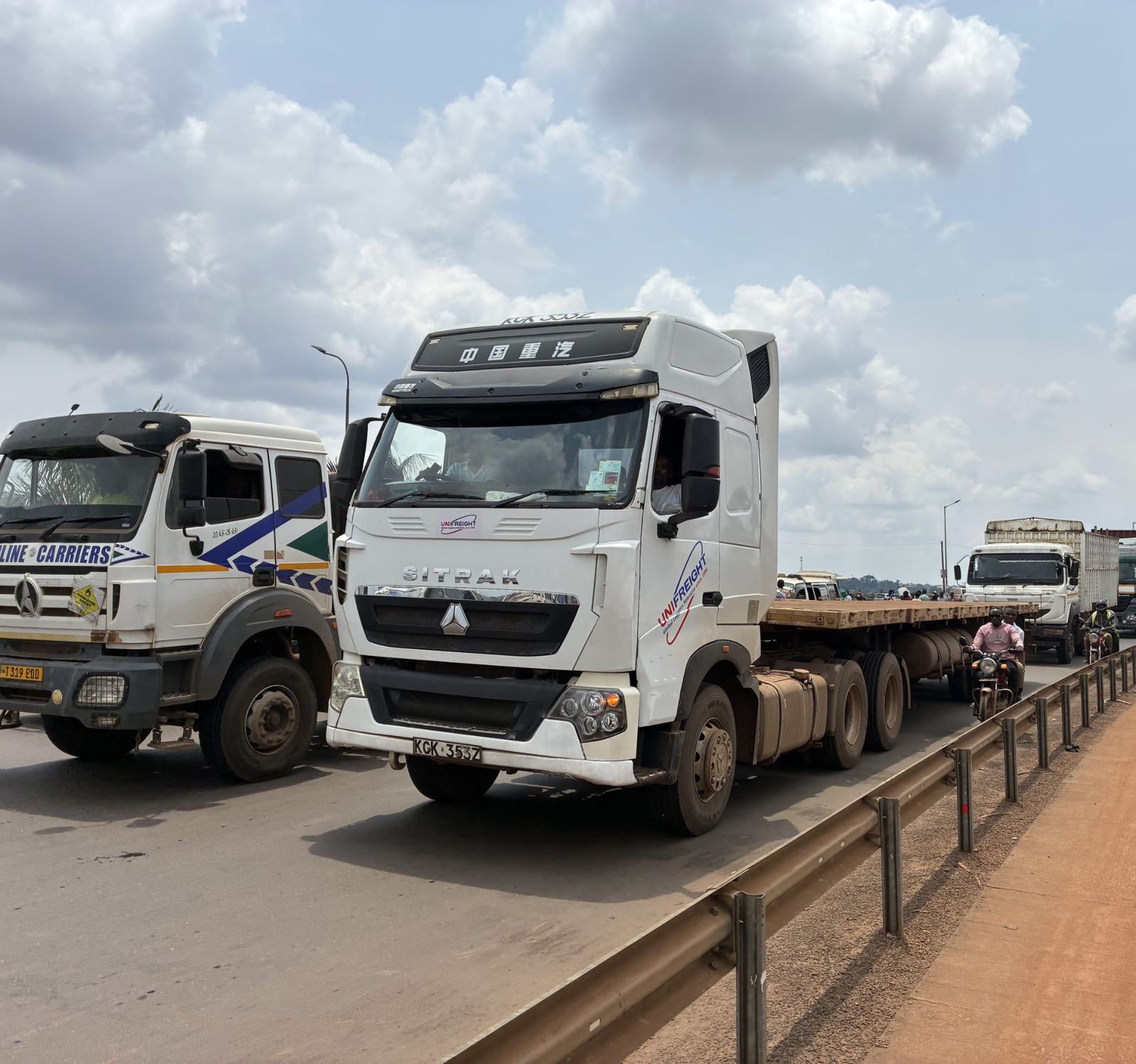
What a truck saves
About USD 40 (≈ UGX 167,000) saved per truck per day. A 50-truck fleet that waits a month leaves about USD 60,000 on the table.
Open the full calculator →USD. Modelled from UNBS-tested consumption: 60,000 km a year, 46.0 L/100 km. Results vary by vehicle and duty cycle.
Imagine a Kampala haulier. Every day, fuel eats up around half of his operating costs. One day, his trucks are fitted with a retrofit that Uganda’s standards bureau has tested. Because of that, each truck burns 14 litres less every 100 km. Until finally, he is quoting jobs his competitors can’t match, and the kit has paid for itself out of the fuel he no longer buys.
Measured, explained and ready to fit
How it works
A bolt-on unit makes hydrogen and oxygen from distilled water on demand, so the diesel burns more completely.
Six steps → 02The proof
Independently tested by UNBS to ES 7074:2024 (Test Report EL/2026/00154). Government testing in Uganda, Ethiopia and Rwanda.
See the results → 03Ways to get it
Buy for your fleet, price on order. Or register for the pay-from-savings pilot, with nothing upfront.
Compare options →What would 30% less diesel do for your fleet?
Same work, on less diesel
A compact, bolt-on unit uses a small current from the vehicle’s electrical system to split distilled water into hydrogen and oxygen (HHO). The gas is fed into the engine’s air intake, where it makes the diesel burn more completely, so the engine does the same work on less fuel.
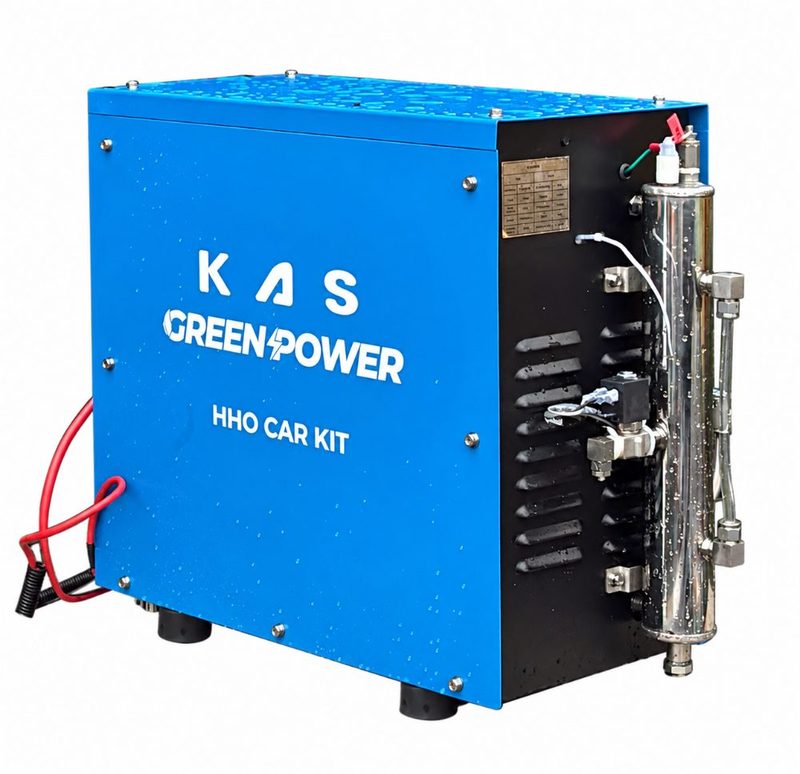
From water tank to a more complete burn
{{ cur.t }}
{{ cur.what }}
{{ cur.fleet }}
What it means on the road
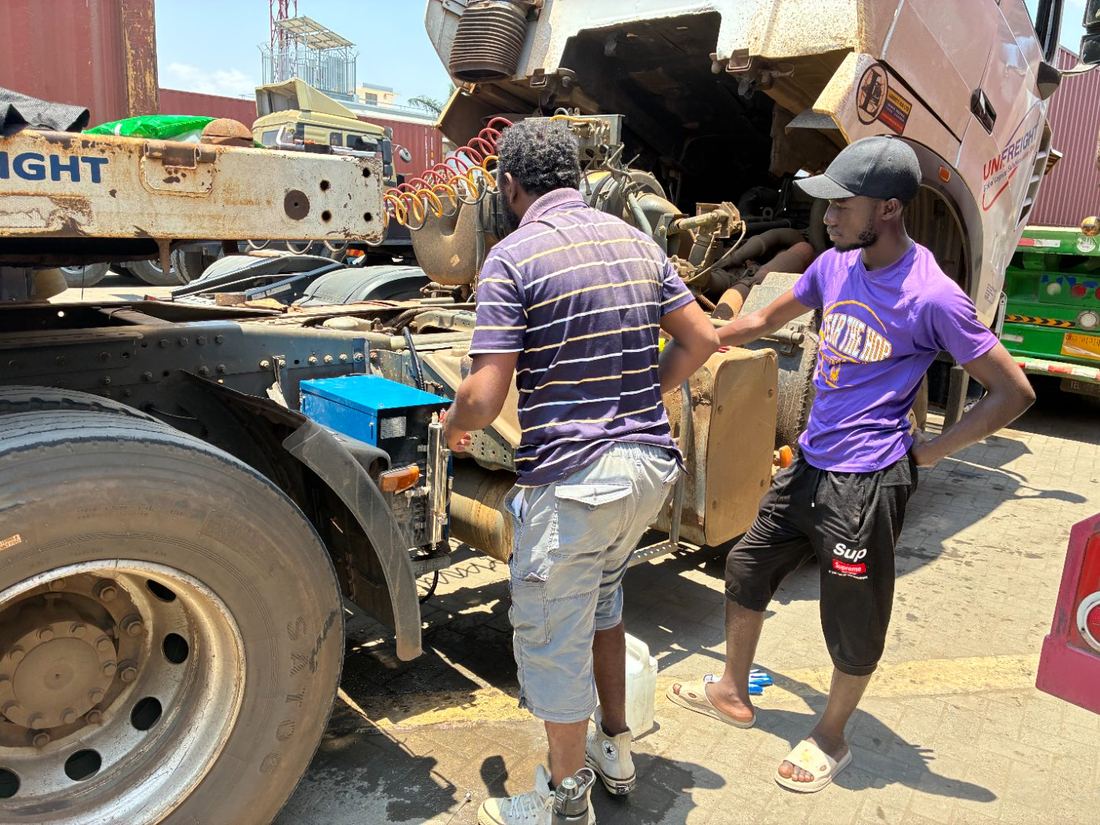
No engine changes
No internal engine modification. No change to the fuel tank.
Back on the road the same day
Fitted in under 4 hours.
Nothing stored
No gas is stored. It is made on demand and used instantly.
350 cc to 40,000 cc
Works on diesel, petrol, LPG and CNG engines.
Trucks to generators
Trucks, buses, cranes, construction and mining plant, and generators.
Less carbon fouling
Reported benefits include longer oil-change intervals and lower maintenance costs. Reported, not tested
Built to the national HHO standard
The unit must not reduce engine power, torque or alternator life. UNBS recorded no torque loss at a full 13 t load.
UNBS · EL/2026/00154 · 18 FEB 2026- Flashback barrier and non-return valve
- Emergency stop with manual reset
- No auto-start after power loss
- Engine-bay installation only
- Pressure-relief valve
- 316L electrolyser rated to 150 °C
It is not a fuel cell, and the vehicle does not “run on water.” Water is the feedstock for on-demand gas, and the gain comes from more complete combustion.
What the kit saves your fleet
Enter your own figures. The calculation applies the 30.65% fuel reduction UNBS recorded on a loaded 13 t truck.
Default diesel price: Kampala, 21 Oct 2026 (Nile Post). Prices change often, so enter your own.
Your exact payback is confirmed with your order.
Book a free fuel audit →Estimates based on UNBS-tested consumption. Results vary by vehicle and duty cycle. CO₂ at 2.68 kg per litre of diesel.
One heavy truck, one year
Modelled from UNBS-tested consumption on a loaded 13 t truck: 46.0 L/100 km without the kit, 31.9 L/100 km with it.
Tested by government, not by us
If you’ve heard “run your truck on water” claims before, you’re right to be sceptical. So we didn’t rely on our own tests. Uganda’s national standards authority tested our retrofit. In a separate Ethiopian Ministry of Transport trial, a rival fuel-saving device showed no reduction at all. Ours did.
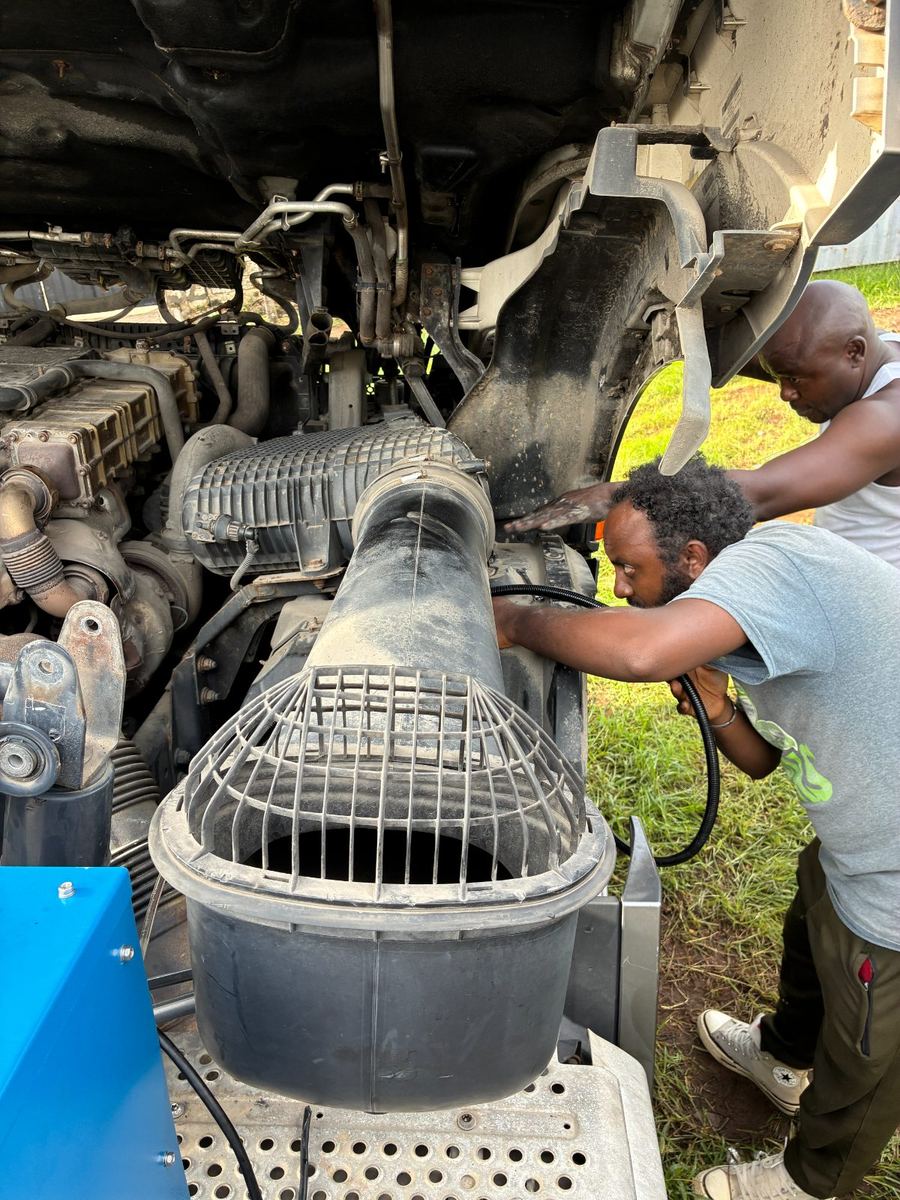
Independently tested by UNBS to ES 7074:2024
Sino Truck with the HCK-250 kit. ECU odometer and fuel readings via SAE J1939, analysed by UNBS. No torque loss, no leaks, no ECU fault codes.
Uganda, Ethiopia and Rwanda
UNBS
30.65% less fuel on a loaded 13 t truck, 31.54% unloaded. Tested 17 February 2026.
UNBS · EL/2026/00154Ministry of Transport & Logistics
Fuel savings shown on an Isuzu truck, a Toyota Hilux and a Toyota Vitz. A rival device in the same trial showed no reduction.
MoTL Ethiopia · Field test · Oct 2023REMA
Two vehicles inspected before and after fitting: significantly reduced exhaust emissions.
REMA · Inspection · Apr 2026Patented technology
Utility models ET UM1112B1 (Ethiopia) and KE 485 (Kenya).
Built to ES 7074:2024
The national HHO-generator standard, used by UNBS as its test method.
Deployed in four countries
Uganda, Kenya, Ethiopia and Rwanda.
Buy it, or pay from your savings
Buy for your fleet
Price on order
- Free baseline fuel audit from your trucks’ ECU data
- Installation in under 4 hours by certified technicians
- Driver orientation and an in-cab quick-reference card
- One-year warranty on electricals, plus repair-or-replace
- Monthly savings statement (litres, money, CO₂)
Order request received. We’ll contact you to arrange your free fuel audit.
Pay from your savings
Nothing upfront
We fit the kit. You repay a share of the fuel you actually save, measured from your truck’s own engine data, over 6–12 months. Then the kit is yours, and so are 100% of the savings.
Also included: a share of carbon revenue once credits are issued.
Pilot places are limited to 300–500 vehicles across Uganda.
Indicative terms · The pay-from-savings programme is in development. Terms are indicative.
Registration received. We’ll be in touch about pilot places.
Pilot eligibility: a roadworthy vehicle, high annual mileage, and consent to fuel and telematics monitoring.
Questions operators ask
It sounds like you’ve been burned by fuel-savers before. Here’s what’s different.
A government-tested diesel retrofit that pays for itself from the fuel it saves.
Our mission: cut the fuel bills and emissions of Africa’s existing diesel fleet now, through locally built, standards-compliant technology and finance that operators repay from their savings.
Tested and deployed in four countries
KAS Energy UG is part of Afri UK, an international group headquartered in London that works with African governments, private enterprise and development institutions. We have a manufacturing plan for Uganda.
The people behind KAS



Book a free fuel audit
We read your trucks’ own ECU data to set a baseline before anything is fitted.
P.O. Box 6257, Kampala, Uganda
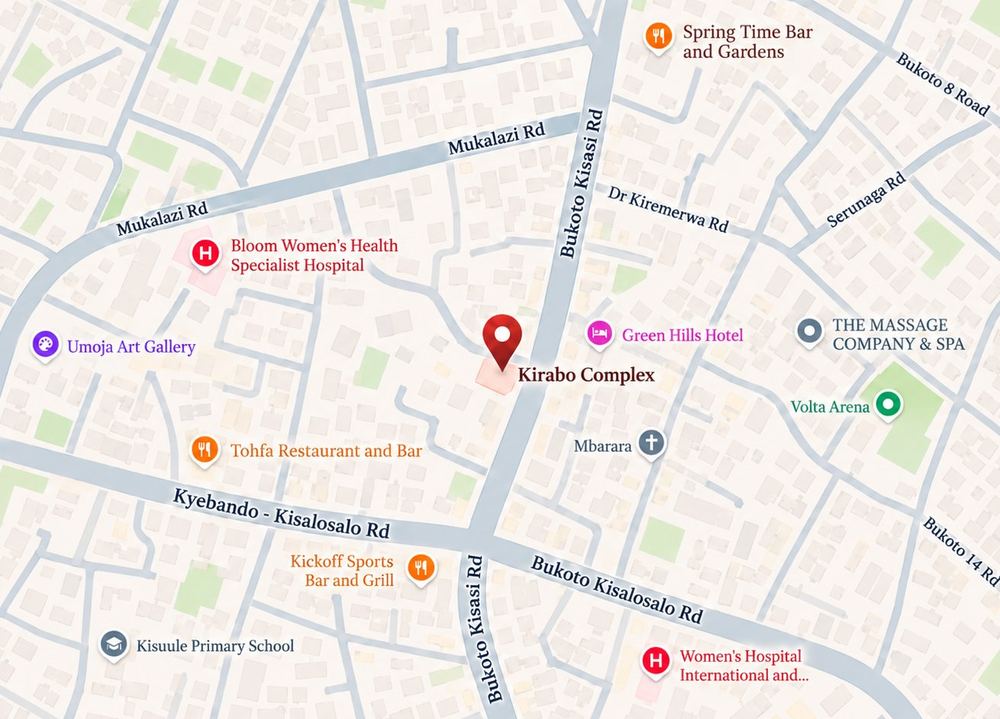 Open in Google Maps →
Fuel audit or order
Request received. We’ll contact you to arrange the next step.
Sources & references
Ministry of Finance, Planning & Economic Development (Uganda), Macroeconomic & Fiscal Performance Report FY2023/24, Table 3
https://mepd.finance.go.ug/documents/MFP/MFP-FY202324.pdfTibesigwa et al. (2024), Frontiers in Energy Research, using Ministry of Energy & Mineral Development data
https://www.frontiersin.org/journals/energy-research/articles/10.3389/fenrg.2024.1403014/pdfUganda National Oil Company (UNOC), “UNOC@10: a decade of progress” (sole-importer volumes)
https://www.unoc.co.ug/unoc-10-a-decade-of-progress-and-transformation-in-ugandas-oil-and-gas-sector/Daily Monitor, Energy Minister on national consumption of 8 million litres a day (29 Apr 2026)
https://www.monitor.co.ug/uganda/news/national/minister-nankabirwa-warns-of-higher-fuel-prices--5440194Daily Nation, “Fuel price shock pushes freight costs up 14pc” (Kenya Transporters Association)
https://nation.africa/kenya/news/fuel-price-shock-pushes-freight-costs-up-14pc-5424080Nile Post via allAfrica, “Uganda: Fuel at the pump, the dollar in the market and the cost of losing confidence” (21 Oct 2026)
https://allafrica.com/stories/202610220721.htmlDaily Monitor, “Shilling in free fall, fuel on fire” (11 Oct 2026)
https://www.monitor.co.ug/uganda/news/national/shilling-in-free-fall-fuel-on-fire-5628206UNBS Electrical Laboratory, Test Report EL/2026/00154, 18 Feb 2026 (available on request)
Request from the Evidence Room →Ethiopian Ministry of Transport & Logistics, Field Test Report, Oct 2023 (available on request)
Request from the Evidence Room →REMA Rwanda, inspection ref. IRNRWA0100320260413112502, Apr 2026 (available on request)
Request from the Evidence Room →A metered route to financing efficiency on Africa’s existing diesel fleet
KAS Energy UG manufactures, installs and services a hydrogen-on-demand retrofit for diesel engines. In February 2026, UNBS recorded a 30.65% reduction in fuel consumption on a loaded 13-tonne truck.
UNBS · EL/2026/00154 · 18 FEB 2026Evidence Room
Government testing, documented field tests, standards and IP, with every source available on request.
The Fuel-Savings Fleet Facility
A special-purpose vehicle that funds retrofits, is repaid from metered savings and adds a carbon-revenue layer.
The facility is in design with climate-finance partners. Terms are indicative.
Impact, measured from the engine
Savings are metered from SAE J1939 ECU data and aggregated for carbon MRV under Verra VMR0004.
Leadership & Group
Directors, the inventor of the technology, and the group behind KAS Energy UG.
Proven efficiency retrofits stay unfinanced
lack the upfront cash and collateral.
cannot yet underwrite how the technology will perform.
are too fragmented to reach carbon finance.
Efficiency retrofits on the existing fleet are the only near-term lever
Uganda spent US$1.78 billion on oil imports in FY2023/24 (up from US$1.64 billion in FY2022/23).
Ministry of Finance, Uganda · Macroeconomic & Fiscal Performance Report FY2023/24 · Table 3≈ US$4.5 billion a year: the estimated value of Uganda’s imported fuel at the pump. That is about 2.6 billion litres × diesel at about UGX 7,190 a litre (≈ US$1.74 at Shs4,140/US$), in October 2026. The retail value includes taxes, transport and margins, so it is higher than the import bill. Prices have risen from about UGX 6,510 in June 2026.
KAS estimate · Pump prices: Nile Post, 21 Oct 2026 · Volumes: UNOCAbout 2.6 billion litres of fuel imported a year, and rising. National consumption is about 8 million litres a day (April 2026).
UNOC · Sole-importer data 2024–25 · Daily Monitor, Apr 2026Fuel can be around half of a truck operator’s costs in East Africa. The Kenya Transporters Association puts it at about 55% of road-freight operating costs.
Kenya Transporters Association · Daily NationNational energy modelling assumes Uganda’s freight fleet stays on diesel to 2050, because electric freight is not yet viable. That makes efficiency retrofits on the existing fleet the only near-term lever.
Tibesigwa et al., Frontiers in Energy Research, 2024Fuel-Savings Fleet Facility
A special-purpose vehicle that funds retrofits, is repaid from metered savings and adds a carbon-revenue layer.
The Facility →KAS hydrogen-on-demand retrofit
30.65% fuel reduction and under 4 months payback on a heavy truck.
UNBS · EL/2026/00154Where we are
- Government testing
- Documented field tests
- National standard
- Utility models
- Unit economics
- Carbon pathway reviewed
- Facility structure
- Capital stack
- Financial model
- Investor soundings
What was tested, by whom
Government-tested
Tests run or supervised by national authorities. UNBS, Uganda: 1 heavy truck, loaded and unloaded · Ethiopian Ministry of Transport & Logistics: 3 vehicles · REMA, Rwanda: 2 vehicles, inspected before and after fitting.
Documented field tests
Road tests with full written reports, run by the group’s engineering teams, across Uganda, Kenya and Ethiopia.
R&D programme
Development and calibration testing during product development.
Test Report EL/2026/00154
- References
- RFA/2026/1927 · sample L/0191/2026T
- Dates
- Tested 17 Feb 2026 · signed 18 Feb 2026
- Location
- Bweyogerere Industrial Park, Kampala
- Method
- ES 7074:2024
- Vehicle
- Sino Truck with the HCK-250 kit
- Data
- ECU odometer and fuel readings via SAE J1939, analysed by UNBS
- No torque loss
- Engine temperatures within OEM limits
- No leaks
- No ECU fault codes
- Emergency stop, grounding and overcurrent protection verified
24 VDC, about 900 W (peak 27 A), 30 A fuse, 250 L/h ±10% H₂, output ≤ 0.25 MPa, splash-resistant.
Ministry of Transport & Logistics
Field test, October 2023, with the Environmental Protection Authorities, the Ethiopian Standards Institute and the Ministry of Planning & Development. Fuel savings were shown on an Isuzu truck, a Toyota Hilux and a Toyota Vitz. A rival device tested in the same trial showed no reduction.
Followed by a Certificate of Competence and ministry support letters.
MoTL Ethiopia · Field test · Oct 2023REMA
April 2026 inspection of 2 vehicles, before and after fitting: significantly reduced exhaust emissions.
REMA · IRNRWA0100320260413112502 · Apr 2026Documented field tests
Around 15 vehicles with full written reports: Mercedes-Benz Actros and other heavy trucks, Isuzu and Foton trucks, Iveco 380, Tata Daewoo, a LOXA/Foton 55 t crane, and Toyota Hilux, Prado, RAV4 and Vitz. Kenya results report up to a 45% increase in km per litre.
Company field tests · Uganda, Kenya, Ethiopia
The standard, and the utility models
All available on request
No downloads. Requests go to daniel@kas.energy.
Pay-from-savings, in six steps
- 01The facility buys the kit, KAS installs it, and the operator leases it at zero upfront cost.
- 02Savings are metered from the vehicle’s ECU fuel data (J1939).
- 03The operator repays a fixed share of verified savings (indicatively 40–60%, with a floor and a cap) over 6–12 months.
- 04Title passes to the operator at the end of the term.
- 05KAS carries the performance risk through a warranty and a repair-or-replace guarantee.
- 06Emission reductions are aggregated across fleets under Verra VMR0004. The carbon revenue is shared and acts as credit enhancement.
Repayment linked to metered data, not the operator’s balance sheet
Installs; carries performance risk (warranty, repair-or-replace)
Meters fuel; savings verified per vehicle
Carbon revenue shared; acts as credit enhancement
- Under 4 months payback on a heavy truck, inside a 6–12-month tenor, gives strong debt-service cover.
- Repayment is linked to metered data, not to the operator’s balance sheet.
- The facility is technology-agnostic: any independently verified efficiency measure can join.
vehicles across 10–20 Ugandan operators (10–200 vehicles each), prioritising SMEs. Expansion to Kenya, Rwanda and Ethiopia.
The facility is in design with climate-finance partners. Terms are indicative.
Finance removes the upfront barrier
Retrofits are installed
Metered fuel savings
Lower costs, less imported diesel and fewer emissions
Carbon revenue and a performance record bring in commercial lenders
- Litres saved
- t CO₂e avoided (about 22.7 t per truck per year, modelled)
- USD saved by operators
- Repayment performance
- Technicians trained and certified
- Electrolyte is handled and disposed of under ES 7074:2024 procedures.
- Only certified technicians install, with mandatory leak testing.
- Every driver gets a safety briefing at handover.
From engine data to verified credits
Target: 30% women among trained and certified technicians, and 40% in assembly and manufacturing roles, by Year 3 (from about 20% in Year 1).
- Installation and maintenance in Uganda
- A manufacturing plan for Uganda
- About 200 technicians trained and certified per year at scale (target)
Pilot fleet, first Ugandan assembly line, 80 technicians trained.
Rollout across Uganda; first exports to Kenya and Rwanda.
Export markets expand to South Sudan, Tanzania, Ethiopia and DRC.
KAS commits its own Stage-1 capital.
Made in Uganda. Powered by clean energy. Exported to Africa.
Part of Afri UK
Afri UK is an international group headquartered in London that works with African governments, private enterprise and development institutions, with operating presence in Kampala, Nairobi and Addis Ababa.
Green Tech Africa
EV import and assembly, technician training with SOS Children’s Villages, and microfinance partnerships for green-asset loans.